
Ford Mustang GT3 — the JOBARD Racing livery on iRacing and Le Mans Ultimate
June 1, 2026 · Livery · iRacing · Le Mans Ultimate · GT3
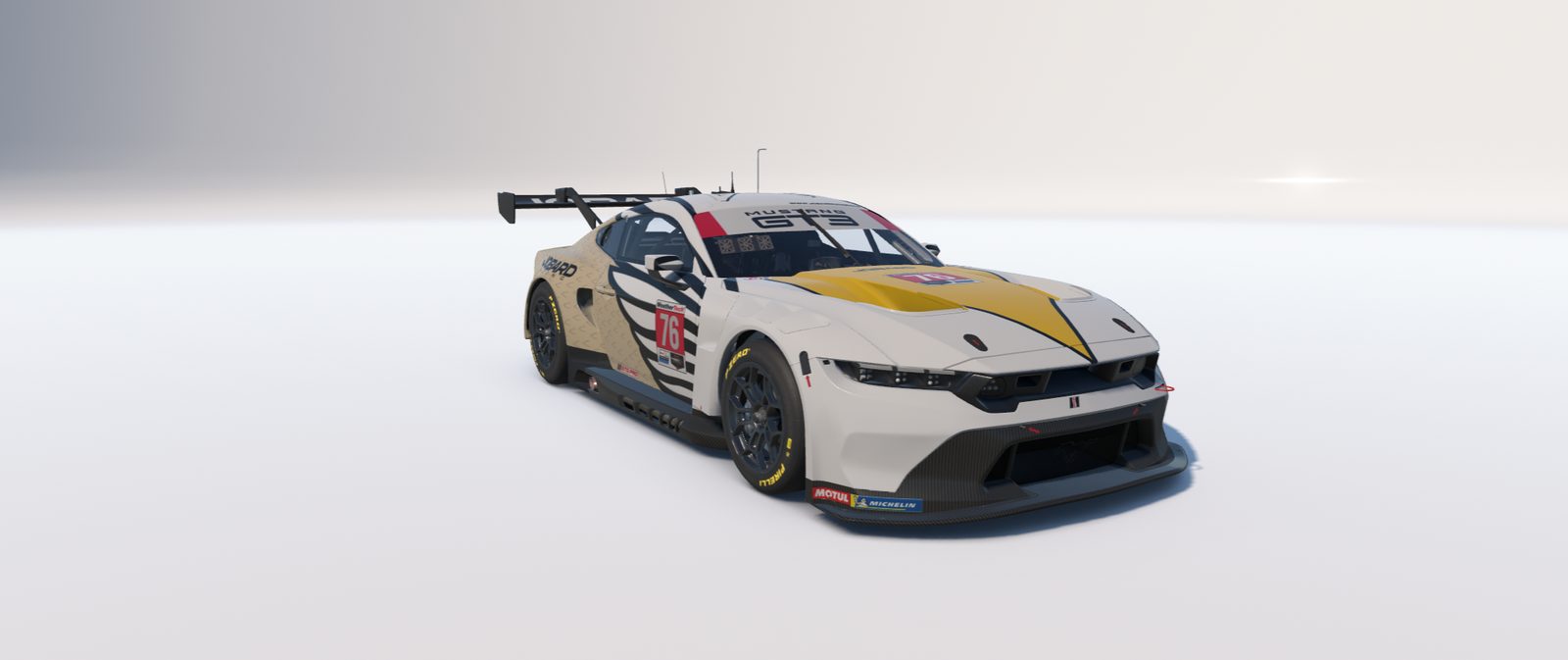
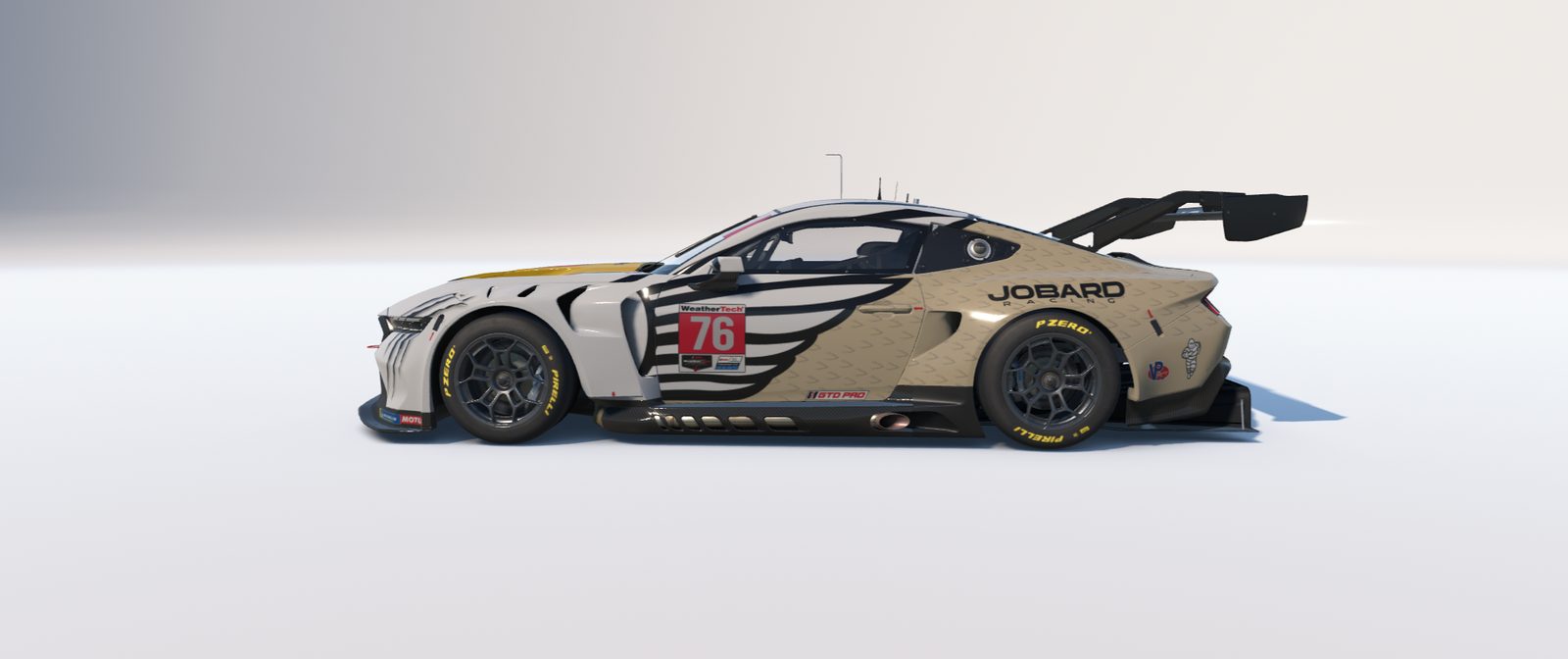
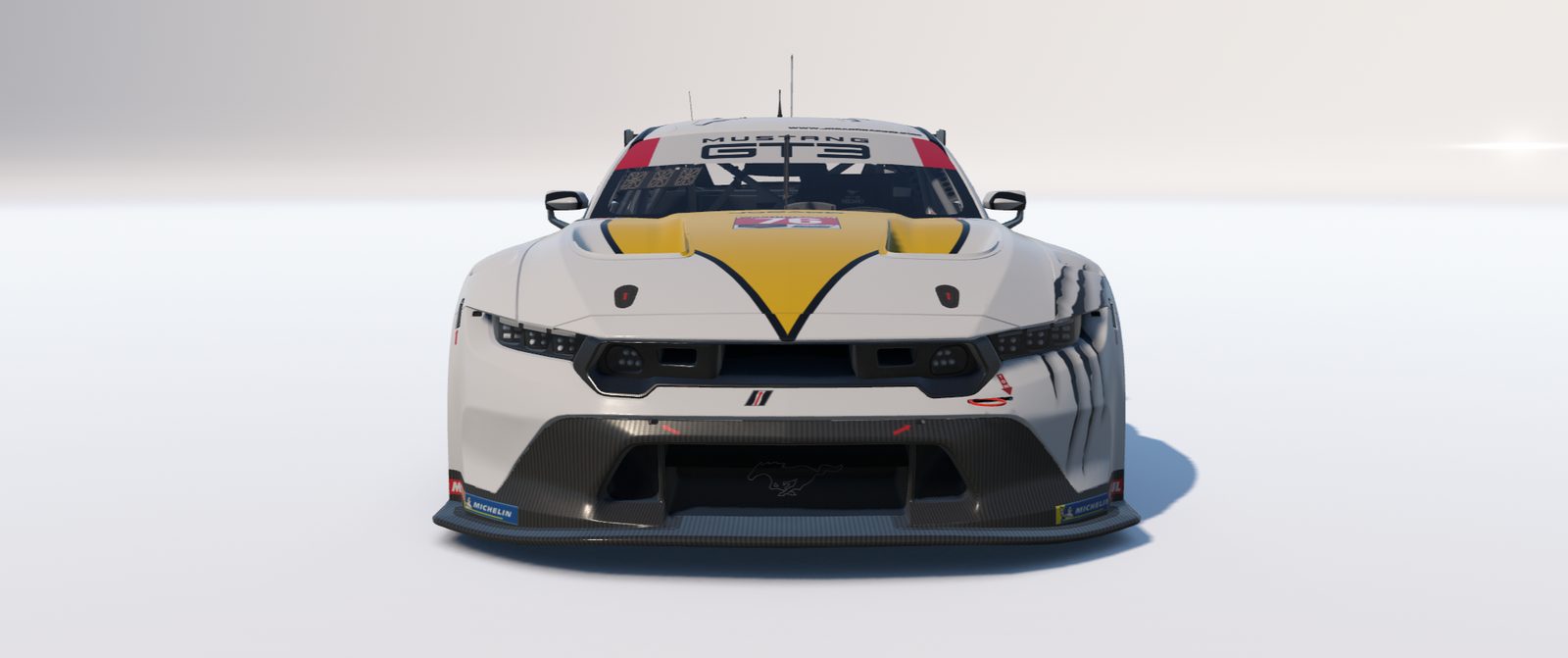
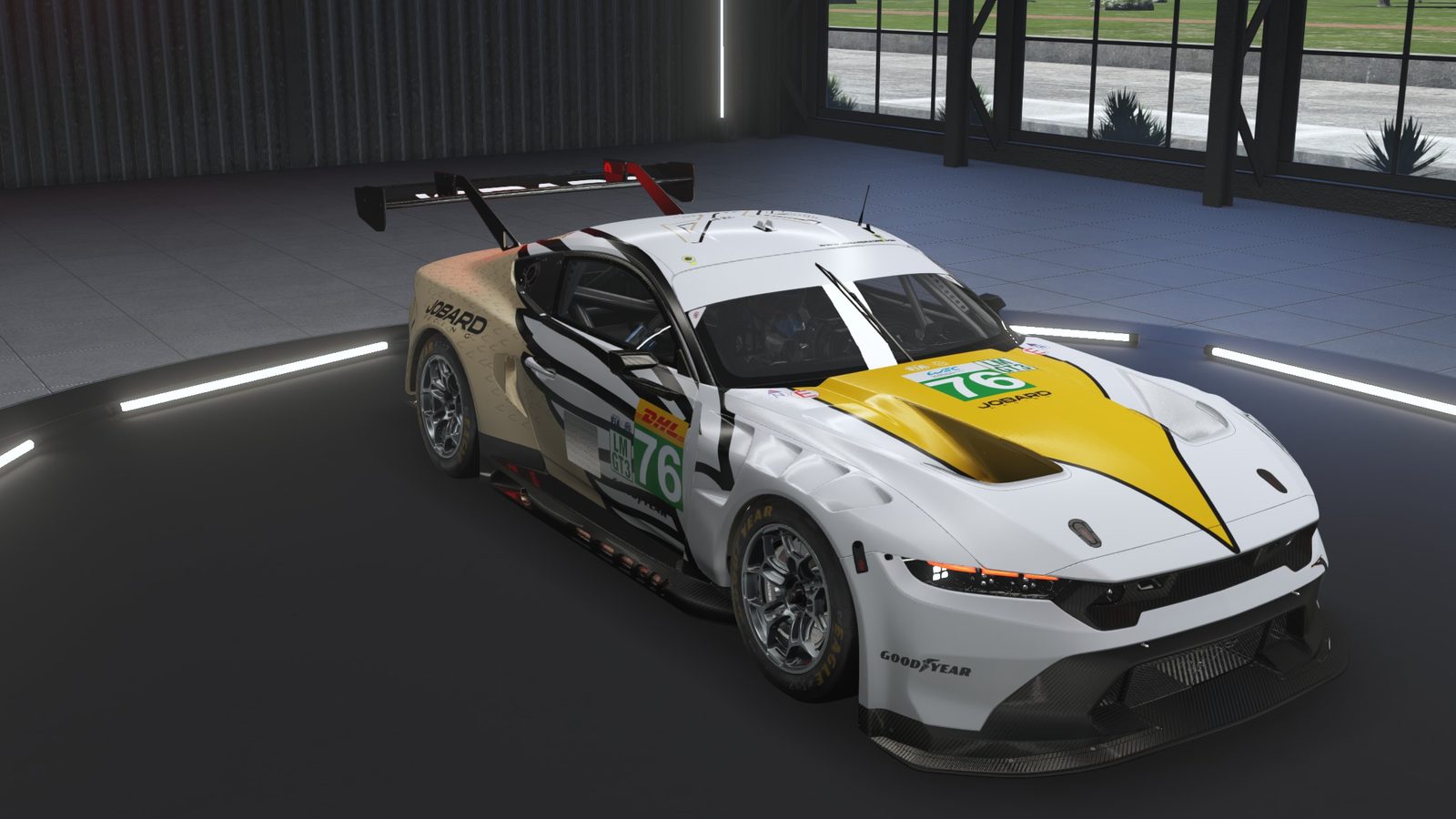
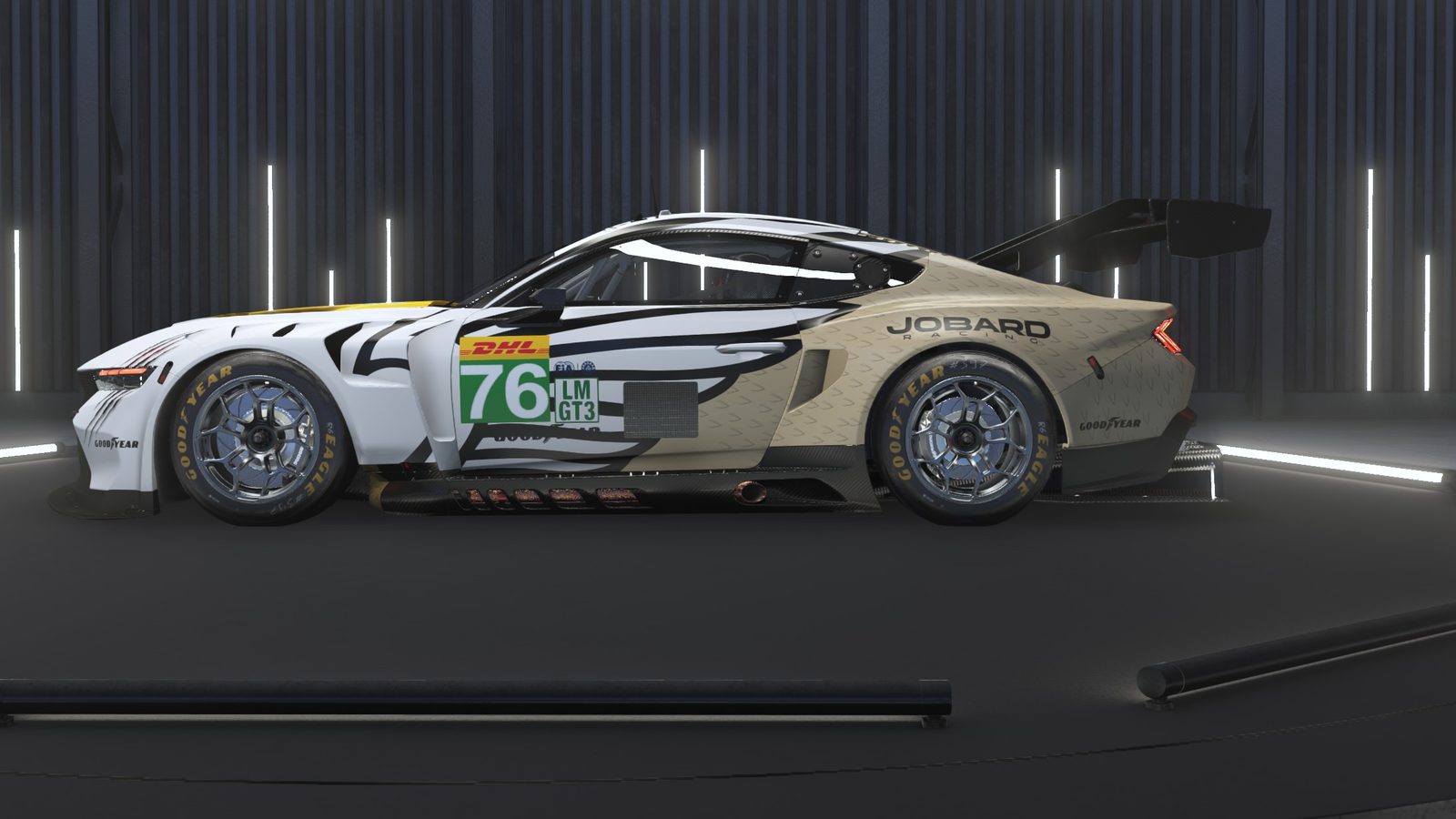
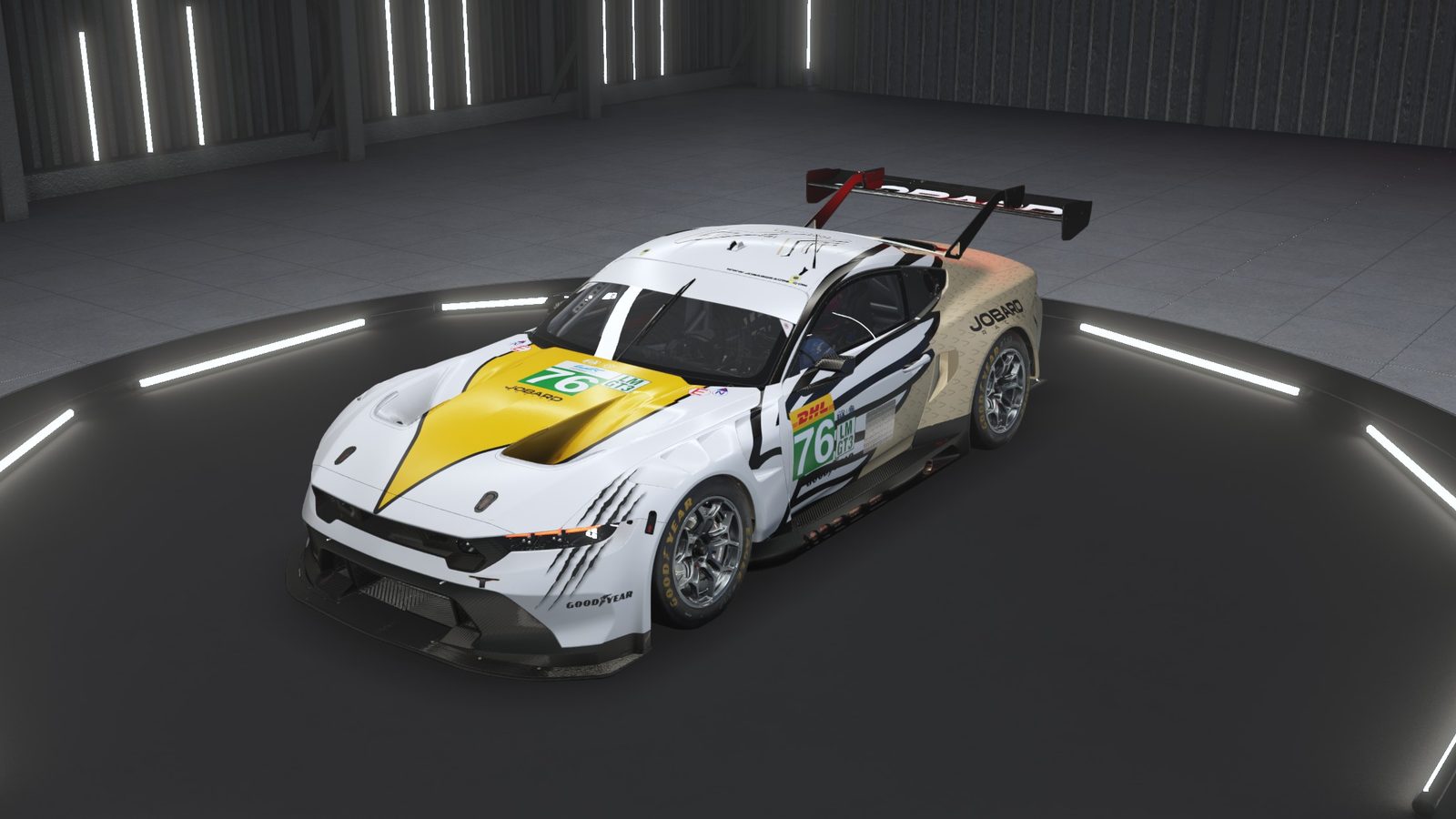
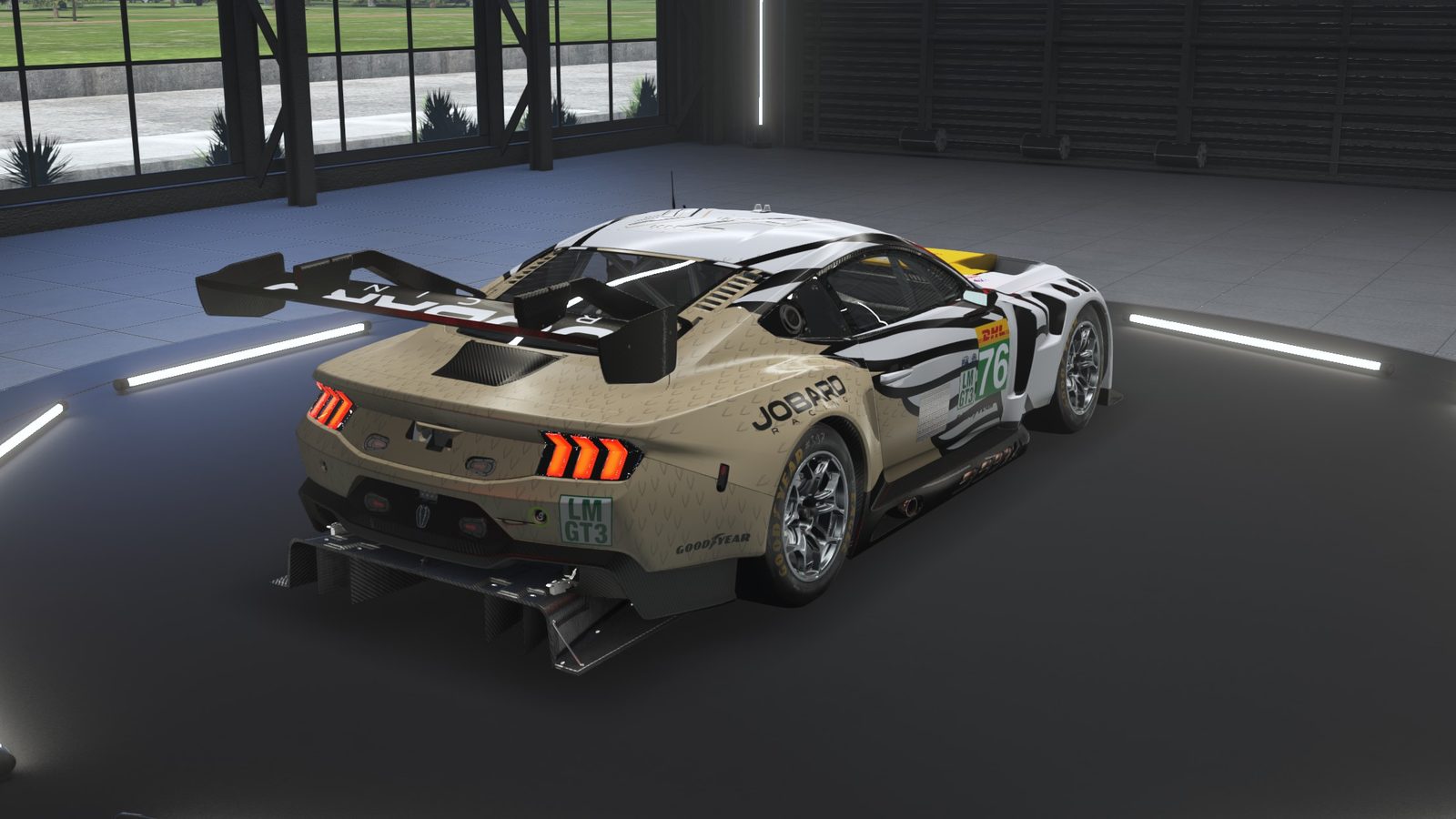
JOBARD Racing unveils its livery for the Ford Mustang GT3, rendered on both iRacing and Le Mans Ultimate. A GT3 with a strong character, dressed in the team's colours.
The Ford Mustang GT3 — the car beneath the livery
Before it is a canvas, the Mustang GT3 is a racing car built by Ford Racing and Multimatic Motorsports. Under the bonnet, a naturally aspirated 5.4-litre Coyote V8, developed in partnership with M-Sport, paired with an Xtrac six-speed sequential gearbox mounted close to the rear axle for optimum weight distribution.
The chassis carries the hallmarks of Multimatic: DSSV dampers with five-way adjustment, double-wishbone suspension on both axles, and an FIA-homologated integrated roll cage. The first cars were fitted with Alcon discs; the Evo specification moves to Brembo.
Unveiled at Le Mans on 9 June 2023, it made its competitive debut at the 2024 Daytona 24 Hours. What followed speaks for itself: a podium at the 2024 Le Mans 24 Hours, a maiden overall victory at the 2025 Daytona 24 Hours, and a class win at the 2025 Nürburgring 24 Hours. It currently competes in the FIA World Endurance Championship, IMSA, GT World Challenge, and the DTM.
This is the car the race team fields — with the same surface constraints and legibility demands as its real-world counterpart.
A recognisable signature
Sand bodywork, gold accents, touches of black and white: the Mustang carries the team's chromatic signature — the same one that connects every car we run. On the bonnet and flanks, number 76 bearing the Griffy griffin, the team's mascot, alongside the JOBARD Racing mark.
What a livery must hold at 250 km/h
A racing livery is judged under hostile conditions. It is seen from a three-quarter rear angle, at full speed, on a compressed video stream, often on a phone screen. Three demands follow, and they governed every decision on this Mustang.
- The number must read before the brand. The 76 occupies the doors and bonnet at full height, on a light background that holds contrast even against the light.
- The signature must survive cropping. The stripes and sand remain identifiable in a tight shot as much as in an aerial view, keeping a ten-second clip signed throughout.
- Consistency takes precedence over variation. A race team is recognised by what does not change from one car to the next: the same griffin, the same palette, from GT3 to Hypercar.
Anything else — flattering gradients, patterns that read well at a standstill but disappear on track — does not pass that test.
One livery, two simulators
The race team does not separate its venues: the same identity dresses the Mustang across both reference simulators. Each platform has its own custom livery system, and the two work differently.
On iRacing
iRacing uses 24-bit TGA files with RLE compression, at 1024 × 1024 or 2048 × 2048 pixels, placed in Documents\iRacing\paint\ under the relevant car folder. Files follow the naming format car_<customer number>.tga, with separate files for gloss mapping and the custom number.
One important detail: other drivers only see a custom livery if they have the file. That is the purpose of Trading Paints, a third-party service that distributes liveries and displays them in-race for those who have it installed.
On Le Mans Ultimate
Le Mans Ultimate works with two uncompressed TGA files: customskin.tga for the design and customskin_region.tga for material definition. Templates are supplied with the game, in the Support\LiveryTemplates folder of the installation.
Files are placed in UserData\Liveries, reloaded from the built-in showroom to adjust materials, then submitted for validation. Once approved, the livery is assigned to a crew entry and used in online racing.
A coherent fleet
The Mustang GT3 joins a fleet built around the same visual rigour: Corvette Z06 GT3.R, Porsche 911 GT3 R, Ferrari 296 GT3. A race team is also recognised by its consistency — the same griffin, the same palette, from one car to the next.
A livery is a signature: that of a race team building itself, race after race.
Every angle is gathered in the gallery on the Racing page. And on track, live on the Twitch channel.
Frequently asked questions
Is the JOBARD Racing livery available to download?
No. The race team's liveries are reserved for the cars it fields. They are not distributed on Trading Paints or anywhere else.
Who builds the Ford Mustang GT3?
It is developed and produced by Ford Racing together with Multimatic Motorsports, Ford's partner across its motorsport programmes.
What engine does the Mustang GT3 run?
A naturally aspirated 5.4-litre Coyote V8, prepared for competition in partnership with M-Sport, mated to an Xtrac six-speed sequential gearbox.
When did the Mustang GT3 make its racing debut?
At the 2024 Daytona 24 Hours, approximately six months after its reveal at Le Mans on 9 June 2023. It took its first overall victory at Daytona in 2025.
How does one install a custom livery on iRacing?
By placing a 24-bit TGA file at 1024 × 1024 or 2048 × 2048 pixels in the Documents\iRacing\paint\ folder corresponding to the car, named car_<customer number>.tga. For other drivers to see it in-race, the livery must be published through Trading Paints.
And on Le Mans Ultimate?
By preparing two uncompressed TGA files — customskin.tga and customskin_region.tga — from the templates supplied with the game, then loading them from the built-in showroom and submitting them for validation before assigning them to a crew entry.
Read next
Toyota TR010 Hybrid — the JOBARD Racing Hypercar livery on Le Mans Ultimate
The race team steps up to Hypercar with its livery on the Toyota TR010 Hybrid, on Le Mans Ultimate: sand and gold signature, zebra stripes, the number 76 bearing the Griffy griffin. With an explanation of the shift from GR010 to TR010 and how custom liveries work in the game.
June 7, 2026Read →6 Hours of Road America — the race team's race report
Race report from the 6 Hours of Road America (Chevrolet Corvette Z06 GT3.R, Guillaume Jobard / Jonathan Ribeiro): a heavy accident, 17 minutes of repairs, and a recovery from 25th to 19th in GT3.
July 25, 2026Read →6 Hours of Interlagos — the race team's race report
Race report from the 6 Hours of Interlagos (Chevrolet Corvette Z06 GT3.R, Guillaume Jobard / Jonathan Ribeiro): a deliberate wet-weather gamble that did not pay off, finishing P16 GT3 (P26 overall).
July 18, 2026Read →