
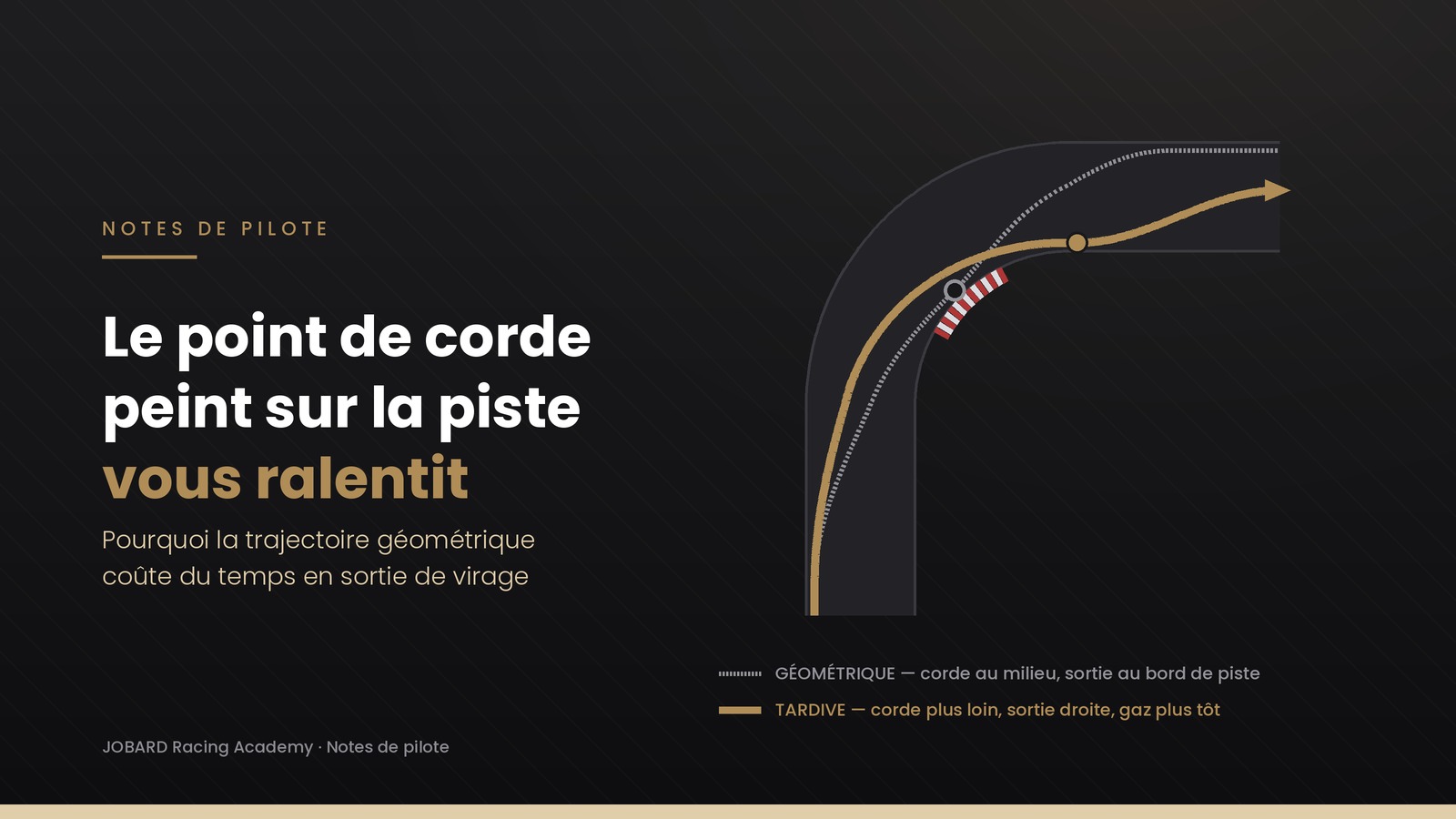
Circuit apex: the painted kerb is slowing you down
September 19, 2026 · Driver's Notes · Driving Technique · Academy
Every circuit offers you one reference free of charge: the inside kerb, often painted, placed exactly where the eye expects the apex. You see it coming, you target it, you clip it. The sensation is excellent. The lap time, however, does not move.
This is one of the most stubborn ceilings in sim racing, and it is not broken by braking later or by searching for grip. It is broken by accepting a counter-intuitive idea: on most corners, the fastest line passes through a later apex than the one the track shows you, and it takes you through the corner itself at a lower speed.
The painted mark is not an instruction
The inside kerb is there for three reasons, and none of them is your lap time. It defines the track limit for the marshals, it gives every driver a common visual reference, and it prevents cutting. It is almost always placed at the geometric apex: the midpoint of the curve, the point that allows the greatest possible radius from entry to exit.
That point is perfectly defined mathematically. The problem is that it solves a problem that is not yours.
The geometry does not lie — it answers the wrong question
The geometric line maximises radius. A greater radius, for the same level of grip, allows a higher speed. So far, everything is correct — and that is precisely why the intuition is so convincing.
But what that line optimises is cornering speed. Yet a lap is not won in the corners: it is won on the straights, and the corners are simply the means of entering them. What matters is therefore not your speed at the apex, but your speed at the end of the straight that follows.
There is a second reason, a physical one. A tyre has a single grip budget, shared between holding the car through the corner and transmitting power. Both draw from the same reserve. As long as you are at the lateral limit, nothing remains for acceleration. The geometric line keeps you at that lateral maximum for as long as possible: it therefore prevents you from getting back on the throttle early. That is precisely the opposite of what you want.
And it has a third, very concrete flaw: exiting on an arc that is still curved, you reach the edge of the track with steering lock applied. You must then lift, or run wide onto the grass. Many drivers conclude they lacked grip. They lacked space above all, and they had spent it two seconds earlier.
The one question that determines the apex
Before every corner, the question to ask is not "where is the apex". It is: what comes next?
If what follows is a straight, the corner has only one role: to propel you into it as quickly as possible. Everything else is secondary, including your cornering speed. You therefore enter more gently, turn in later, place the apex further into the corner — and exit with the car already nearly straight, which allows full throttle much earlier.
This is what is known as a late apex. It will cost you a few km/h at the slowest point of the corner. That is the price, and it is a good price.
What you lose at entry, what you gain over eight hundred metres
Take the order of magnitude, without seeking precision: you exit a corner at 120 km/h instead of 117, because you were able to get back on the throttle half a second earlier. Both cars then accelerate in the same way — same engine, same gear. The advantage does not erode: every metre of straight converts it into time gained.
Over eight hundred metres at speed, that amounts to one to two tenths. On a single corner. Repeated across the four or five corners of a circuit that open onto a genuine straight, that is the second per lap separating the midfield from the top five.
Conversely, the few km/h the geometric line earns you at the apex are spent within three tenths of a second, across a zone only a few tens of metres long. The benefit is real; it is simply tiny and without consequence.
The cases where the geometric apex remains correct
The late apex is not universal, and applying it everywhere costs time as well.
It does not apply in fast corners taken at or near full throttle. There, you are not limited by traction on exit but by pure lateral grip; the greatest radius becomes the right answer again, and the geometric apex is the correct one.
It does not apply to a corner immediately followed by a braking zone either. If there is no straight beyond it, there is nothing to make the exit worthwhile: you may as well carry speed through.
And it does not apply to a corner that is merely a passage to the next. Which brings us to the most rewarding case of all.
Linked corners: the first one is sacrificed
In a sequence, corners are not equal. The one preceding the longest straight governs all the others. You optimise it first, then work back through the sequence, sacrificing each preceding corner to the one that follows it.
In practice: in a double right-hander whose exit leads onto the main straight, you accept being genuinely slow through the first part, taking it very wide, in order to position yourself on the ideal line for the second. A driver who optimises both corners separately will be quicker at the intermediate split, and slower on the lap.
This is also what makes the learning process uncomfortable: the correct line makes you feel slower. That is why you cannot find it by sensation alone. You find it with data.
How to verify it on your own line, not on a guide's
No guide knows your car, your differential setting, or the way you get back on the throttle. The principle is universal; the exact apex is not — it shifts with the car's traction characteristics and with your setup.
The test is straightforward, and sim racing has an advantage here that a real circuit does not: you can run both lines back to back, in identical conditions, as many times as needed.
The trap lies in choosing the right indicator. Do not compare your minimum cornering speed: it will be lower on the correct line, and it will lead you to the opposite conclusion. Compare two things, and two things only: the point at which the throttle pedal goes back on decisively, and the speed reached at the end of the straight. If the second figure rises, the line is better, regardless of what the rest of the trace shows. That is exactly the kind of reading that a telemetry trace makes possible.
One final point, often overlooked: a late apex begins at entry, not at the midpoint. It requires braking carried into the corner rather than completed on the straight — that is, trail braking. The two techniques are not independent: the latter is what makes the former manageable.
Putting all of this into practice across eight rounds, against other drivers, with a championship standings and debriefs, is precisely what our development championship offers.
Discover the JOBARD Racing Academy Series →
In brief
Why does the inside kerb not mark the correct apex? Because it marks the track limit and the geometric midpoint of the corner, not the point that produces the fastest exit. These are two different things, and only the second one matters to the lap time.
A late apex means I carry less speed through the corner. Is that normal? Yes, and it is in fact a sign that you are executing it correctly. You are trading a few km/h over a few tens of metres for several km/h across the entire following straight.
Does this apply to every corner? No. In a fast corner taken at or near full throttle, or in a corner immediately followed by a braking zone, the geometric apex remains the correct one. The late apex is justified when there is a straight to make the most of beyond the exit.
How do I handle a sequence of corners? By working backwards from the end. The corner preceding the longest straight is optimised first; every corner before it is sacrificed to it, working back through the sequence.
Which figure should I look at to know whether I am right? The speed at the end of the straight, and the point of throttle application. Above all, not the minimum cornering speed, which systematically points towards the wrong line.
Read next
Sim racing setup: the 6-step method for setting up your car
A setup is not dialled in through successive attempts but in a precise order — tyres, ride height, aero, springs, dampers, differential. Each step sets the reference for the next.
September 5, 2026Read →Sim racing race preparation: the 48-hour check-list
Forty-eight hours before the start, there is little left to learn — yet almost everything that costs you a round is still decided in this window. The check-list we apply at the JOBARD Racing Academy Series.
September 4, 2026Read →Trail braking: braking later is not enough
Braking later does not save time. Trail braking — progressively releasing the brake as you turn in — loads the front axle and frees up earlier acceleration.
August 1, 2026Read →