
Trail braking: braking later is not enough
August 1, 2026 · Driver Notes · Driving Technique · Academy
You have probably heard the advice before: "to find time, brake later." It is one of the most common reflexes among drivers starting out in endurance sim racing — and one of the leading causes of spins at corner entry. Moving your braking point back serves no purpose if deceleration is not managed all the way to the apex. The real key is trail braking: progressively releasing the brake pedal while overlapping the beginning of the corner. Here is why, and how to work on it.
What is trail braking?
Trail braking consists of continuing to brake as you turn in, reducing pedal pressure progressively as you add steering angle. Instead of completing all your braking in a straight line and then releasing at once, you "trail" the brake towards the inside of the corner.
The benefit is mechanical: as long as you are braking, the car's weight stays on the front axle, which loads the steering tyres and increases their grip. The result: the car turns more willingly, points more decisively towards the apex, and you can carry a higher corner-entry speed.
Why it works: weight transfer and the traction circle
Two principles are enough to understand the technique.
The first is weight transfer. Under braking, the car's mass shifts forward: the front tyres press harder into the track, their contact patch grows, and with it their capacity to generate lateral grip. If you release the brake at once before turning, the weight returns to centre and you enter the corner with an unloaded front axle — one that runs straight on.
The second is the traction circle: a tyre has a finite amount of grip, shared between braking and turning. At 100% braking, nothing remains for cornering. At 0%, everything is available for the turn. Trail braking means travelling down this circle — you return grip to the tyre, degree by degree, as you trade braking force for steering angle. A linear release is therefore the physical expression of a clean corner entry, not a stylistic flourish.
The myth of "late braking"
Braking later is appealing because it is visible: it feels aggressive, as though you are "holding on" longer. On the stopwatch, however, it is often counterproductive.
When you move your braking point back without changing your technique, you arrive too fast at an apex you have not prepared. Two things happen: either you are still braking hard while turning and the front axle breaks away (understeer), or you release everything at once and the brutal weight transfer pivots the rear (oversteer). In both cases, you lose the corner exit — and the exit determines your speed along the entire following straight.
In other words: gaining two metres under braking is worthless if you lose three tenths at the point of acceleration.
What telemetry reveals
This is where data settles the debate. Overlay two laps in your analyser (VRS, MoTeC, or the traces from your Race Engineer): one lap braked "all straight then released", and one lap in trail braking.
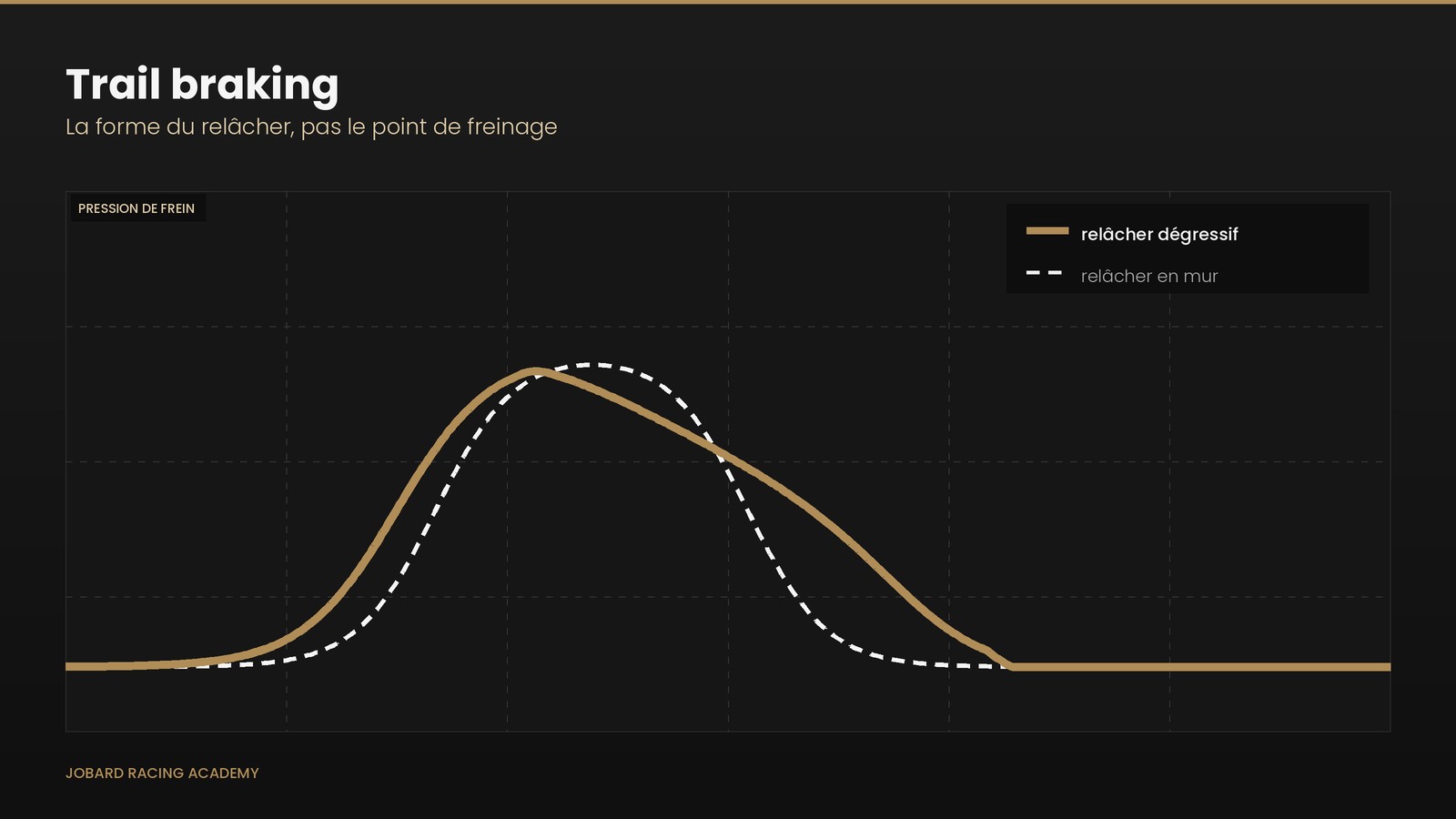
On the brake trace, the trail braking lap shows a smooth descending ramp — pressure decreasing progressively from 100% to 0% through corner entry — whereas the "abrupt" lap shows a vertical wall that drops off at once.
On the speed trace, the trail braking lap retains a higher minimum speed at the apex, and above all rises earlier: acceleration begins a few metres sooner. Those few metres, repeated at every corner, are what make the difference over a stint.
The data does not lie: it is not the braking peak that makes the lap time, it is the shape of the release curve.
A concrete example: La Source at Spa
Take the first corner of Spa-Francorchamps. The La Source hairpin arrives at the end of the pit straight after a heavy braking event — a textbook case, and a mistake there is costly since it carries through the entire Raidillon climb and the Kemmel Straight that follows.
The driver who brakes in a straight line and releases in one block arrives at the apex with an empty front axle: the car runs wide, a correction is needed, and throttle application comes late. The driver who trails the brake keeps the nose planted, rotates through the hairpin without correcting, and gets back on the power sooner. On paper the difference appears small; on the stopwatch it propagates across nearly a kilometre and a half of full load.
This is also why this corner is an excellent training ground: the mistake is immediately readable on the trace, and the gain immediately measurable in the following sector.
How to work on your trail braking
1. Start by braking too early. Move your braking point back only once the release technique is clean. Technique first, aggression second. 2. Separate the two actions. The right foot releases the brake while the hands steer. The release must be linked to steering angle: the more you turn, the less you brake. 3. Focus on pressure, not timing. Do not think "I release at this moment" but "I modulate pressure to keep the nose planted". The car will tell you when it is right: it rotates without sliding. 4. Work corner by corner. Choose a single heavy braking point on the circuit (a hairpin, a big stop) and repeat it in isolation until the brake trace is a clean ramp.
Common mistakes
- Releasing in steps: pressure drops in stages rather than linearly. The car is unsettled at each step.
- Trail braking in every corner: unnecessary in fast corners taken flat. Reserve it for heavy braking events that precede a slow corner.
- Carrying too much brake for too long: if you are still braking at the apex, you are blocking acceleration. Brake pressure must be at zero when you open the throttle.
Key takeaway — Trail braking is not about braking later, but about braking better: a continuous, progressive deceleration that loads the front axle to the apex and frees up early acceleration. Work on the shape of your brake curve before moving your braking point back.
---
Want to read your own traces? The complete method — how to overlay two laps, which graphs to study, and how to turn data into tenths — is detailed in our Telemetry Guide.
To go further on reading curves, see Sim racing telemetry: the 5 graphs that drive progress.
To go further, join the community on Discord and share your traces.
---
FAQ
Is trail braking only for professionals? No. It is a fundamental skill accessible as soon as you are driving cleanly. Done poorly, it unsettles the car; done well, it forgives many positioning errors.
Does it work in every car? The principle is universal, but the calibration changes. A heavy GT3 and an LMP have very different tolerance windows. That is precisely what telemetry helps you calibrate.
Do you need a high-end force feedback wheel? It helps you feel the front axle, but the essentials can be worked on by eye from the brake trace, whatever your equipment.
Which corner should you start with? A heavy braking point preceding a slow corner, leading onto a long straight: the mistake is visible on the trace, and the gain measurable in the following sector.
Read next
Circuit apex: the painted kerb is slowing you down
The painted marker at the edge of the track is a layout reference, not a driving instruction. Targeting that geometric apex costs you exit speed — and exit speed is paid back across every metre of the straight that follows.
September 19, 2026Read →Assetto Corsa EVO safety rating: proximity that pays
In Assetto Corsa EVO, the safety rating no longer simply penalises contact — it rewards the time spent wheel to wheel without touching.
August 18, 2026Read →Sim racing telemetry: the 5 graphs that drive progress
Sim racing telemetry comes down to five graphs: speed, brake, throttle, steering and delta. Here is what each one reveals about your lap, and how to read them to find tenths without complex software.
August 1, 2026Read →