
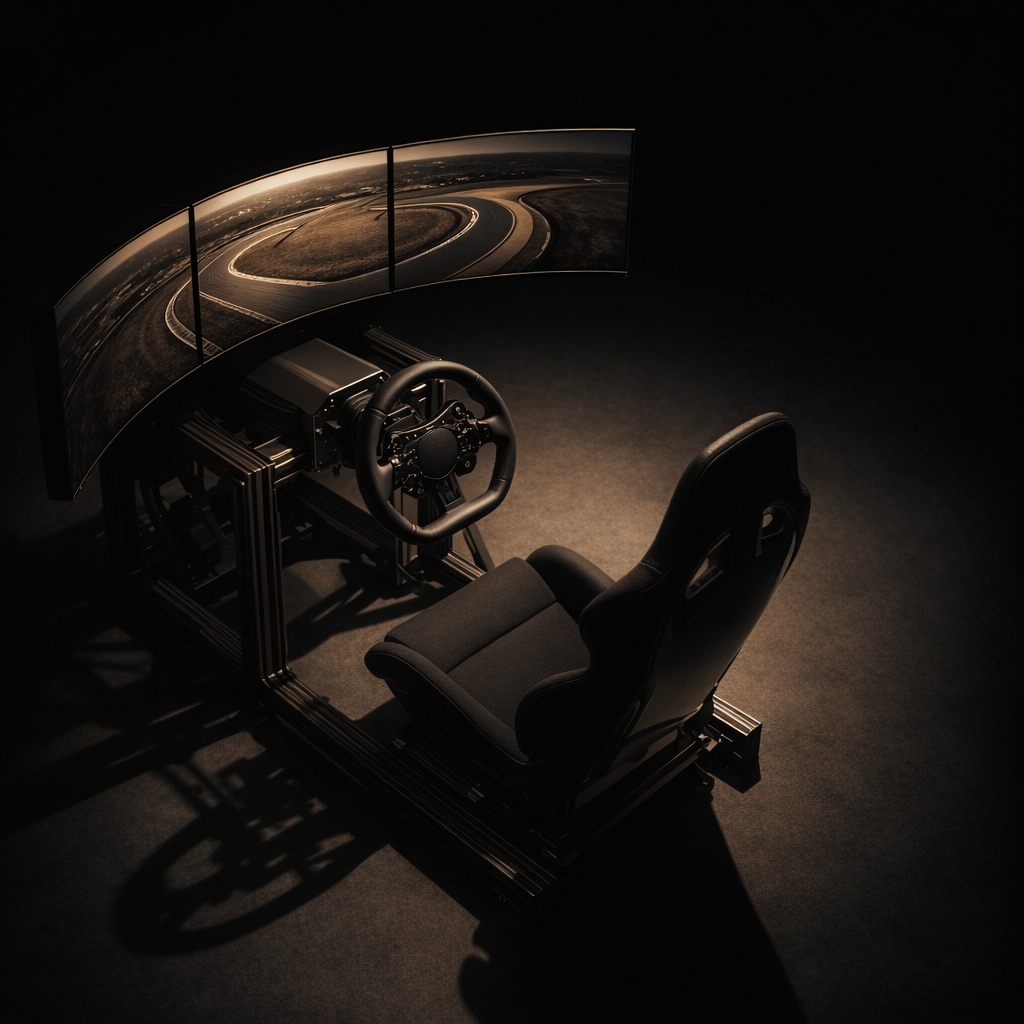
"Getting started on Assetto Corsa EVO: the first-month guide"
June 8, 2026 · Driver's notes · Assetto Corsa EVO · Academy
Assetto Corsa EVO is out in early access and moving fast: the 0.7 update of 3 June 2026 added yet more content. For a beginner, this youth is an opportunity — you discover the game at the same time as its community does. Provided you start in the right order. This guide is the path we recommend to every Assetto Corsa EVO beginner joining the JOBARD Racing Academy: a first month built to progress cleanly, without getting discouraged.
Why start on Assetto Corsa EVO now
EVO rests on a simple foundation: a demanding physics model and laser-scanned circuits. At the time of writing, the simulation offers nineteen tracks — Imola, Suzuka, Sebring, the Nürburgring — and some twenty cars, a catalogue aiming for a hundred by version 1.0. Recent updates added the Audi R8 GT3, two Porsches in the GT2 category and two variants of the Datsun 240Z.
For a beginner, two practical consequences. First, the current content is more than enough to learn: no need to wait for the final version. Second, you are arriving early — the competition is less established than on older simulations, and the gap remains within your reach if you work methodically.
Week 1 — Set up the wheel before anything else
No progress is possible if your force feedback is lying to you. That is the beginner's first mistake: driving for hours on a default setting that does not suit their wheelbase.
The logic is the same whatever your hardware. First set the main gain high in your base's software — 80 to 100% — then adjust the final strength in the game, according to what your wrist can sustain over a full stint. Then work on damping: around 40% Dynamic Damping on a Fanatec base, 30% on Thrustmaster, Minimum Damper at zero and a Damper Gain started low, around 10%. Kunos publishes official starting points for the most common direct drive bases: start from there.
The golden rule: one value at a time. Change one parameter, drive five laps, judge. Force feedback is built in one calm session, not by fumbling with ten settings at once.
Week 2 — Pick one car, one track, and stay there
The second classic mistake is trying everything. Twenty cars, nineteen tracks: the temptation to skim is real, and it is exactly what prevents progress.
Do the opposite. Choose a single GT3 — stable, predictable, representative — and a single circuit you learn by heart. The goal of the week is not lap time, it is consistency: stringing together ten clean laps with less than a second between your good laps. One mastered car on one known track will teach you more than twenty combos sampled.
Use the built-in tools. EVO displays the delta to your personal best lap: that is your first measuring instrument. You see in real time where you gain and where you lose, corner by corner.
Week 3 — Race clean: understanding the Safety Rating
EVO includes a safety rating system, and it pays to understand it early. The principle: clean racing is rewarded, contacts are read from impact data, and the penalty is proportional to severity. The instigator of an incident pays more than the one who suffers it.
For a beginner, the consequence is liberating: you do not need to be fast to rank well, you need to be clean. Leave margin, anticipate other drivers' braking, abandon a move that is not ripe. A high safety rating opens up the interesting servers and grids — it is that, not your raw pace, that conditions your first real races.
It is also the first thing the JOBARD Academy looks at in a driver. Speed can be taught; what we expect from a driver is to know how to race clean first.
Week 4 — Measure to progress
After three weeks, you are driving cleanly and consistently. Time to look at the data. No need for complex software to begin: the JOBARD method holds in five metrics — lap time, consistency, tyre wear, brake temperature, top speed. Each one tells part of your lap and points to a setting to adjust.
This is where a methodical beginner pulls away: they stop "feeling" their mistakes and start reading them. The step up in level comes from there.
Key takeaways - Set up the wheel first, one value at a time — without good FFB, driving is pointless. - One car + track combo, worked until consistent, beats twenty sampled. - Safety rating before lap time: learn to race clean first.
The championship that turns practice into progress
Driving alone has a limit: without a goal, consistency erodes. That is the purpose of the JOBARD Academy Series — eight free rounds on Assetto Corsa EVO, from September to December 2026, broadcast on Twitch. A framework, regular races, and a race team's eye on your progression. The first month described here is exactly the preparation you need to take the start with confidence.
Discover the JOBARD Academy Series →
To go further during this first month, two resources complete this path: our method for reading your telemetry like an engineer, and the free guide to starting out cleanly in sim racing, whose method applies directly to EVO.
In short
Should you buy Assetto Corsa EVO in early access to start? Yes. The current content — nineteen circuits, some twenty cars — is more than enough to learn, and you arrive early on the simulation.
What hardware to start with? A properly set up force feedback wheel matters more than anything else. The base matters less than the time spent setting up your FFB properly.
How long before feeling comfortable? With a single combo worked on consistency and a clean safety rating, a month is enough to take a race start with confidence.